Barcelona is the home of my favorite architect, Antonio Gaudi, and of the moderniste movement. Gaudi’s work is colorful and playful; it embodies his interest in shapes, color, the geometry of nature, and religion. All of his buildings are topped with an off-center cross.
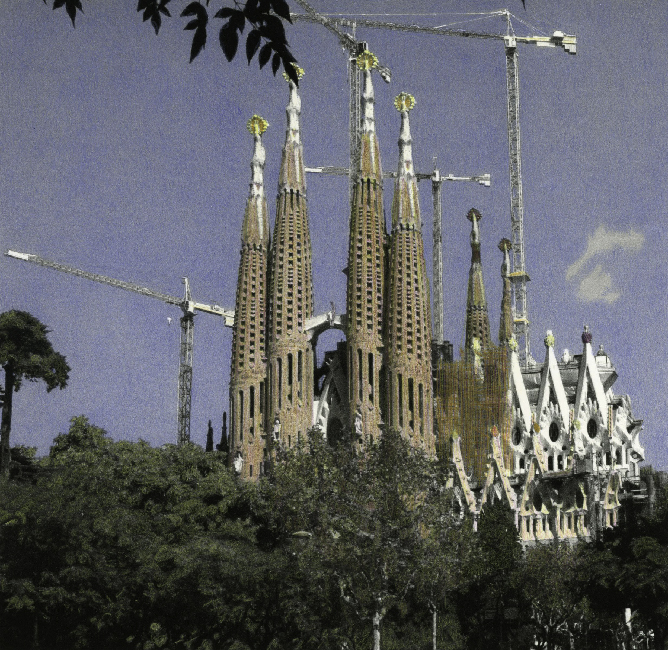
Hands down, Gaudi’s most wonderful creation is the Sagrada Familia, the most visited monument in Spain. Construction was begun in 1882 and continues today, completely funded by donations.
At the time of our visit, the interior was full of construction material, leaving only a path around the circumference. It was interesting to see the forms that will be used to create the interior and inspired us to imagine how the light from the stained glass windows will fall. You can see more images on the poster in the Prints section.
Garcia Lorca worked hard to revive the true form of flamenco, part of which centered on duende. Duende is a source of inspiration achieved by drawing close to the earth and acknowledging one’s own death and the mortality of all things. The great cantoars often reached duende and brought their audiences to tears. Duende has been applied to all of the arts.
Gaudi’s unfinished Church of the Sagrada Familia embodies Lorca’s concept of duende: “Radical change of all forms based on old structures which results in “religious enthusiasm.””
Per Dali’s autobiography, when Garcia Lorca saw the façade of the Sagrada Familia for the first time, he clamed to hear the “griterio’ – a cacophony of shouts (reminiscent of the ‘solea’) – that rose stridently to the top of the cathedral, creating such tension in him that it became unbearable. There is the proof of Gaudi’s genius, he appeals to all our senses and created the imagination of the senses.
